Best of Sheffield - A Sunset & Night Photography Guide

Updated: 4 hours ago
Sheffield is an easy city to underestimate and a difficult one to photograph from the pavement. The centre sits in a bowl. Houses climb the ridges, the River Don and the old works sit on the valley floor, and the skyline reads as a staircase if you get above it. Stainless steel was first made workable here in 1913, but that is context, not the picture. The picture is a post-industrial city on a hill, at its best from about forty minutes before sunset until the streets are properly lit.
I lived here in 2018–19. The photos were made on a full-frame Canon EOS 5D Mark III, so the focal lengths below are 35mm equivalent. This is not every viewpoint in the city. It is the set I would still walk someone to, with a note on season, lens and light, so that everyone can savour the charm of the Steel City.
Sheffield can roughly be divided into four main areas: the central City Centre, the eastern Park Hill & Wybourn, the northern Neepsend & Burngreave, and the western Western Bank & Upperthorpe.
If you only have one clear evening, go to Sheaf Valley Park for sunset and the first of the blue hour, then decide between Parkwood Springs (in winter, compressed skyline) and Bolehills (a high view west toward the Peak District).If you have walked out of the railway station with a tripod and two hours, do the east-side loop in this order: Sheaf Valley Park, Granville Street, Park Square, Lady’s Bridge.
Sheaf Valley Park
Sheffield Railway Station is right on the edge of Park Hill & Wybourn, with the post-war large-scale public housing estate on the hill behind it. From the east exit of the station, climb the stairs to reach Sheaf Valley Park, which is also the city's most accessible viewpoint.

The park faces west, so sunset works in every month. On a good evening the cloud does as much as the skyline. Because the centre climbs away from you, a 35–70 mm standard lens frame can stack rooflines like steps; a short telephoto picks Park Hill’s decks out of the wider view.

Sheaf Valley already has the stepped skyline which makes this spot offers a view of the city skyline unfolding like ascending steps in front of you. The flats and the station take the light at different speeds, which is when the frame stops looking like a daytime snap with the exposure pulled down.
Manor Laith Road

Sheaf Valley is relatively flat. If you want to photograph the ridge behind the skyline, walk up to Manor Laith Road and Skye Edge Avenue. From here it is obvious that a lot of Sheffield’s housing sits above the city and built on higher terrain, not in it.
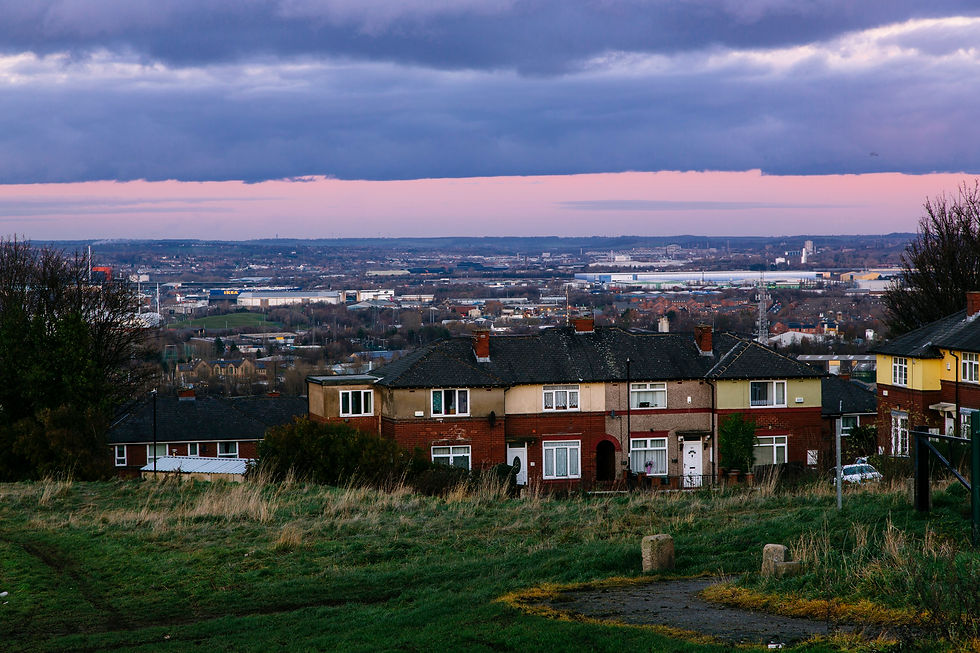
Towards Skye Edge Avenue, you can overlook the plains of the Lower Don Valley, where the large suburb shopping centres: Ikea and Meadowhall located, as well as major heavy industrial zone with steelworks of various sizes situated.

I caught a December moonset here. It is a real moonset spot if you plan it, not a bonus you should count on. A clear winter afternoon is the one to book; summer haze flattens the valley.
Granville Street

Granville Street is actually a small path in between Sheaf Valley and the railway station, and there are walls about head height along this path.
Set a mini tripod on the wall, not on the pavement, and you get the throat of the station: tracks, platforms, and, on a decent evening, colour in the sky behind the trains. I used a Manfrotto PIXI EVO because a full set of legs will not sit on that wall.

Besides the tracks, you can also find spots to photograph the platforms, and pairing them with evening glow can yield some nice photos. This is a working railway. Keep the kit on your side of the wall, and do not lean out for a cleaner angle.
Park Square Roundabout

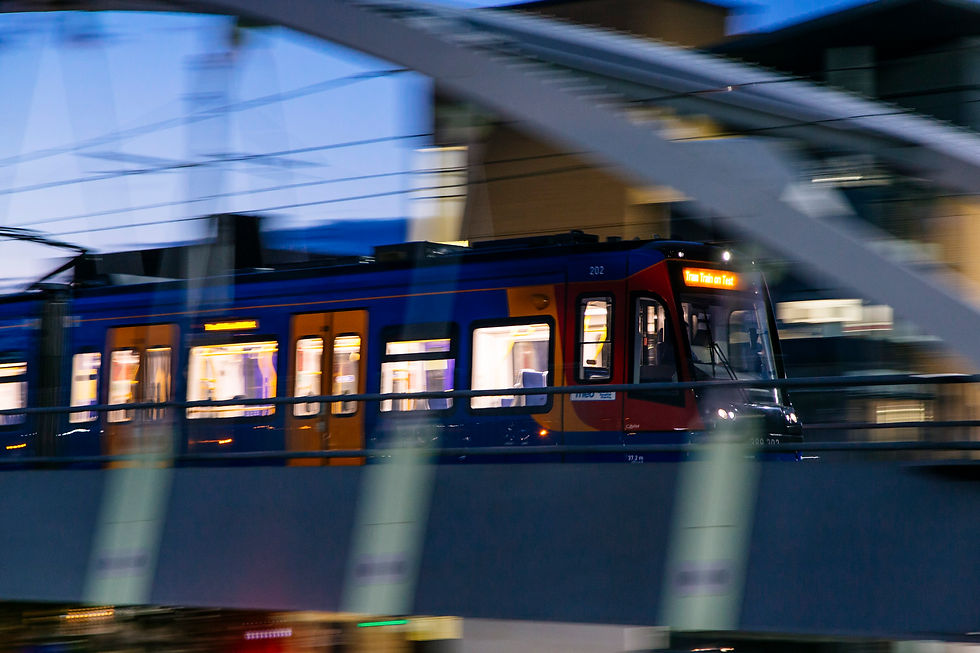
If you walk to the end of Granville Street, you may find a footbridge spanning across Park Square Roundabout, from where you can see the tram flyover area.
Supertram is not frequent enough, and the road traffic is not reliable enough, for one long exposure to draw the trails you want. Shoot a sequence and stack it. Another way to photograph the tram is to slow down the shutter speed and pan through the tram in motion.

The other way off the same bridge is back toward the station, which is worth a frame before you lose the sky.
Lady's Bridge

Sheffield’s old line is that five rivers meet the town. The one that earns its place after dark is the Don, on the north side of the centre. At Lady's Bridge along the River Don, you can capture reflections on the water.


From Lady’s Bridge you get the reflection, and within a short walk the old Town Hall and Victoria Quays. The quays are quiet after the offices empty. I would still shoot them, but I would not do the walk alone with a tripod on the shoulder and no one knowing the pin. Reflections here want still air more than a dramatic sky; a high ISO and a short shutter will waste the water. I have used a ND-100 neutral density filter to reduce the shutter speed for the photo.
Trinity Street

Elevation is the point of shooting Sheffield’s side streets at all. Trinity Street is the one I would send someone to: the slope, the industrial frontages, and enough of the city’s character in a single frame that you do not need a skyline.
A wet evening is better than a clear one. The slope becomes a leading line as soon as the tarmac holds a reflection. A standard 50mm-ish lens would be sufficient.
Town Hall / Fargate

Fargate and the Town Hall are the civic centre, high street of Sheffield, instead of a viewpoint. Vibrant shops and banks are also found lining this street. At night, meter for the stone walls, not the shop windows, or the building becomes a silhouette with a blown highlight in every other pane. Or you may try visit Fargate after 9pm at summer when magic hour arrives while shops are closed and lights are dimmed.
A ultra-wide angle lens is recommended to capture the entire streetscapes.

The present Town Hall was finished in 1897 and still houses the City Council while opening to the public for work and visits.

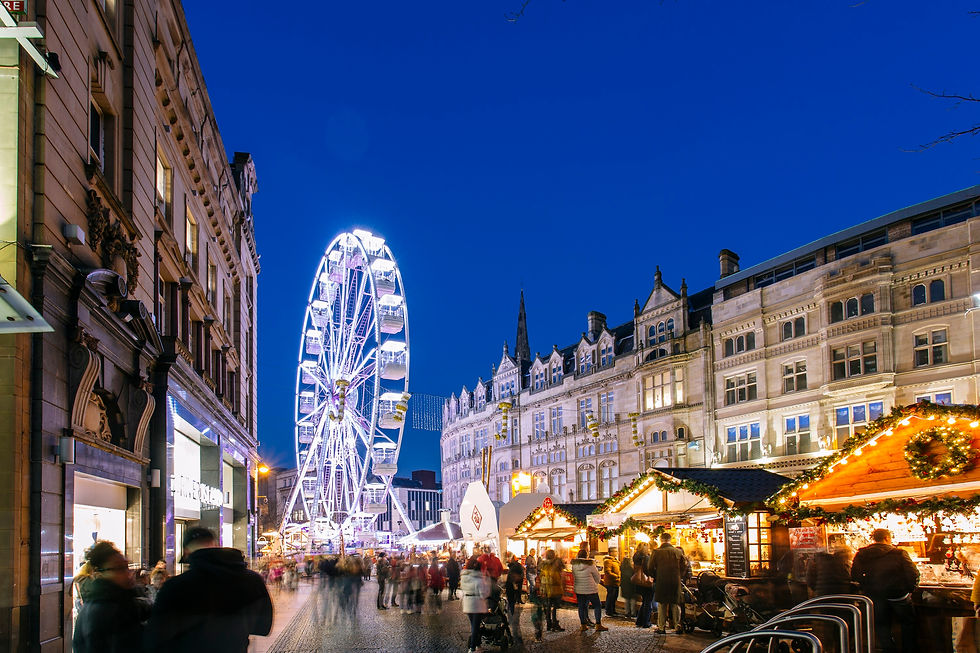
Fargate often hosts various stalls or events. It photographs best when something else is using the square: a market, a fair, rain on the stone. The Christmas market has used this part of town for huts, food and a wheel. Check what event is actually on before you pack for the visit.

Another angle of the Town Hall is available from the Peace Garden, where cherry blossoms and festive settings could be found throughout the years.
Furnival Gate

Located at the periphery of the City Centre, there's the recently rebuilt large shopping street: The Moor, and the food hall in the market is the sensible cheap meal if you are out from lunch until blue hour. If you're unsure where to eat, it's worth a visit.
Nearby Furnival Gate has a multi-storey car park: NCP Sheffield Furnival Gate, from the top of which you can shoot night views of the roundabout and some suburban scenery.

The carpark is close enough to the station to use as a last stop. But you should be aware that the carpark will be closed from 12 at midnight to 6am, such that it is not a overnight viewpoint.
Bridgehouses Roundabout


Having the City Centre spots covered, let's move to the northern Neepsend & Burngreave area. North of the centre was the city’s working industrial district. After World War II and the economic shifts following the oil crisis, a considerable number of industrial sites here have undergone redevelopment in recent years. Kelham Island has taken the best-known slice of the redevelopment; a lot of other sites are still half-turned into offices or flats, which is why so many night frames here look unfinished.
That is the subject, if you want it. Along the Don River near Bridgehouses Roundabout, shoot the relationship between the old sheds and the new residential blocks, not a general “industrial vibe”.
Andover Street

The Neepsend & Burngreave area is characterised by very pronounced elevation differences, and it is steep enough that a short climb becomes a panorama. When I first arrived in Sheffield and happened to come across good weather, I went to Andover Street to shoot a moonrise, but it was not the picture I had talked myself into.

What the spot is actually good for is Netherthorpe with the sunset behind it. Treat moonrise as a planned extra, and check the azimuth rather than turning up because the sky looks promising.
Parkwood Springs
This is the viewpoint I would cross the city for.
If you've seen the YouTube thumbnail photo of my timelapse video created, it's clear that Parkwood Springs is the highlight in this article for a very simple reason: the Sheffield city centre laid out below a fringe of remaining industry, wide enough that a wide-angle lens leaves you with everything and nothing.

Parkwood Springs is on the fringe of the city centre, mainly surrounded by existing industrial operations. Walk up Rutland Road to the park entrance and take the wooded path to the high ground. The view faces mostly south, so sunset belongs to the winter months, when the sun has swung round. In summer you are looking at a panorama with the light dying off to the side.

Upperthorpe’s streets climb the opposite hill in regular lines. That is the telephoto picture, with streets compressed into something like veins.

In general, I would recommend using a standard to telephoto lens instead of a ultra-wide one for Parkwood Springs to avoid lacking focus in the composition.

The council has long planned to turn Parkwood Springs into an outdoor leisure site, with bike trails and a new access. Come while the foreground is still rough.
The Arts Tower, University of Sheffield
Having covered the other areas, now to the final Western Bank & Upperthorpe district. Western Bank is the home to the University, and the Arts Tower is the tall modern building on it: 78 metres, Grade II*, and still the tallest academic building in the UK. When it opened in 1966 it was the tallest in Europe. My planning classes were around here, which is the only reason it is in a sunset guide.
The Arts Tower also houses one of Britain's few remaining Paternoster lifts, which is a fascinating experience to ride.

The frame is indoors. The University usually runs it on weekdays in term time, about 09:00 to 16:30, and does not guarantee it. You do not need to be a student to ride the Paternoster lifts but upper floors are sometimes opened for architecture and landscape shows, but do not count on walking up for a view, and do not come here after dark expecting one.
The Ponderosa

The Ponderosa is one of the larger parks in the district, with several independent apartments nearby. In summer, it's perfect for picnicking while watching the sunset, though that sunset is late. Around the solstice you will need to wait until after 21:00, and the city lights will not be there yet.

Walking a bit further into the park, you'll start seeing distant views. You can capture the Veolia E.S. Waste Treatment Plant with a 200mm telephoto lens and this spot is best in winter to catch the evening glow at the same time. In July it is a grey block against a bright evening.
The Blake Street

Upperthorpe tilts up toward the Peak District, and some of these streets are seriously steep. Blake Street is regularly named among the steepest residential streets in England. From the top you can see distant city views from its highest point.

An older man stopped while I was shooting and said his neighbour, then about ninety, had watched the air raids from this pavement. Sheffield was a steel town on a war footing, and it was hit hard on 12 and 15 December 1940. The story belongs to the street.
The photograph is still the drop of the hill and the lights coming on below. Be aware that it is a residential close, keep the tripod off people’s frontages and don’t linger in anyone’s window.
Bolehills
The other spot I would keep if I had to cut this guide to two: Bolehills.


Bolehills sits on the high ground between Crookes and Upperthorpe. It was a half-hour walk uphill from the Netherthorpe Road tram stop, and the walk itself gives you the view in pieces before you reach the top. Sheffield’s claim to be the greenest city in Britain is really a claim about trees, parks and the Peak District coming over the western boundary.
You will also hear about the street-tree dispute, the PFI fellings and the campaign to stop them. That argument is about the pavements in town more than about this hillside, but it is why “green city” is a sore phrase here as well as a proud one.


From Bolehills you look straight at Rivelin Valley, Stannington and the hills of the Peak. It takes a sunset all year.

With the right light it is also a portrait spot; I had half-planned graduation pictures here and never did them.

A wide frame of Stannington is still one of the photographs I kept from the year.

In June the sky stays bright long after you are ready to go home, and the houses below are late to light up.

In winter you will get the lights, and you will also get the wind. So remember to dress warmly if you come.
--
Sheffield is a rather weak city for sightseeing but a strong one for structure. Industry, housing and the hills are all visible at once, which is why it taught me more about how a city is put together than most places I had photographed, including home in Hong Kong. Despite the weather has the reputation you have heard, over a full year it was less consistently hopeless than that reputation, with enough blue sky and proper sunsets to make the grey weeks feel like the entry fee.
Rivers, ridges, works, trams, blossom, street pictures: not all in one evening, and not all at night, but enough that a photographer who only knows the Peak District as a landscape park, or Sheffield as a station on the way to it, is leaving the better frames on the train.

A quick guide is that if you are arriving by train and the cloud is broken, the station loop still gives you Park Hill, the tracks and the Don River before dinner. If the western sky is the thing that is working, skip the centre and go to Bolehills. Parkwood Springs is the winter compromise: high, wide, and best when the sun is in the south.
As a quick closing remarks, feel free to watch my timelapse video produced alongside these photography journeys in the Steel City of Sheffield.
[This is an AI-translated and re-written article of my writing back in 11th February 2020]


Comments